General News
6 June, 2023
Veterans Voices - Henry Edward Collins
Henry Edward Collins was born in 1892, a native of Murtoa, Yarriambiack. Known as Harry, he was the son of Annie Gerdtry (née Collins, of Murtoa) and the late William Henry Collins, and he had a half-brother, Private Robert Alexander Gerdtry. Harry...
Henry Edward Collins was born in 1892, a native of Murtoa, Yarriambiack.
Known as Harry, he was the son of Annie Gerdtry (née Collins, of Murtoa) and the late William Henry Collins, and he had a half-brother, Private Robert Alexander Gerdtry.
Harry attended Murtoa State School.
Before he enlisted Harry was a farm labourer working at Burrumbullock, but he travelled to Ballarat to sign up.
He noted on his enlistment form that he was single.
However, he was in fact already married and had a son, Henry August Collins, born in April that year.
His wife, Emma Theresa Collins, formerly of Arthur Street, Fairfield, was living with her parents at Murtoa, although her address was later given as 21 Clyde Street, Surrey Hills, in Melbourne.
Harry enlisted as a private with the 8th Battalion Australian infantry on August 27 1914.
His service number was 767.
The battalion was the first Victorian regiment recruited after war was declared.
Harry had had previous experience in the Citizens Military Forces, having served three years with the 73rd Infantry of the Victorian Rangers.
Harry was 5’10” tall, weighed 168 pounds and was a Roman Catholic.
He left Melbourne on October 19 1914 with the first contingent on HMAT Benalla (A24).
He landedin Egypt but subsequently left on April 5 1915 aboard Clan McGilvarry.
Harry went ashore at Gallipoli on April 25 1915 as part of the second wave of Australian and New Zealand troops.
On May 6 the battalion disembarked at Cape Hellas in support of the British in their attempt to capture the town of Krithia.
It was during this battle that Private Henry Edward Collins was killed in action on May 8 1915 at Krithia, Gallipoli, Turkey.
He has no known grave: "Known Unto God".
However, Harry is memorialised on panel 52 at the Australian War Memorial in Canberra.
He is also commemorated at the Helles Memorial, Gallipoli, on Panel 203 to 206 or 332 and at the Murtoa Memorial Gates.
The battle of Krithia resulted in the brigade losing nearly a third of its strength.
His widow was granted a pension of £52 per year and at war's end Harry was posthumously awarded the 1914-15 Star, the British War Medal and the Victory Medal.
[PANEL]The battle of Krithia
The eight-month campaign at Gallipoli was fought by Commonwealth and French forces in an attempt to force Turkey out of the war, to relieve the deadlock of the Western Front in France and Belgium, and to open a supply route to Russia through the Dardanelles to the Black Sea.
The Allies landed on the peninsula on April 25–26 1915: the 29th Division at Cape Helles in the south and the Australian and New Zealand Corps north of Gaba Tepe on the west coast, an area soon known as "Anzac".
On August 6 further landings were made at Suvla, just north of Anzac, and the climax of the campaign came in early August when simultaneous assaults were launched on all three fronts.
However, the difficult terrain and stiff Turkish resistance soon led to the stalemate of trench warfare.
From the end of August, no further serious action was fought and the lines remained unchanged.
The Commonwealth forces successfully evacuated the peninsula in December 1915 and early January 1916.
[PANEL]Memorials to the missing
The Helles Memorial stands on the tip of the Gallipoli Peninsula.
It is an obelisk over 30 metres high that can be seen by ships passing through the Dardanelles.
The memorial serves the dual function of being a Commonwealth battle memorial for the whole Gallipoli campaign and also a place of commemoration for many of those Commonwealth servicemen who died there and have no known grave.
The United Kingdom and Indian forces named on the memorial died in operations throughout the peninsula, the Australians at Helles.
There are also panels for those who were lost at sea in one of the troopships sunk off Gallipoli.
More than 20,000 names are commemorated on this memorial.
There are four other memorials to the missing at Gallipoli.
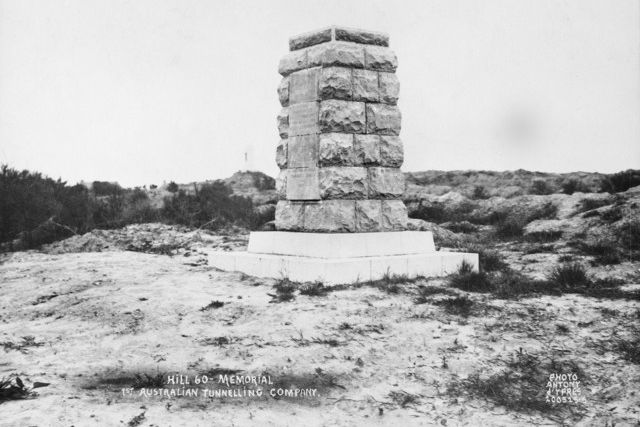
The Lone Pine, Hill 60 and Chunuk Bair memorials commemorate Australian and New Zealanders at Anzac.
The Twelve Tree Copse Memorial commemorates the New Zealanders at Helles.
Naval casualties of the UK lost or buried at sea are recorded on their respective memorials at Portsmouth, Plymouth and Chatham at home in the UK.