General News
7 December, 2024
Veterans' Voices:
John Walter Francis was born in Croxton near Hamilton in 1892.
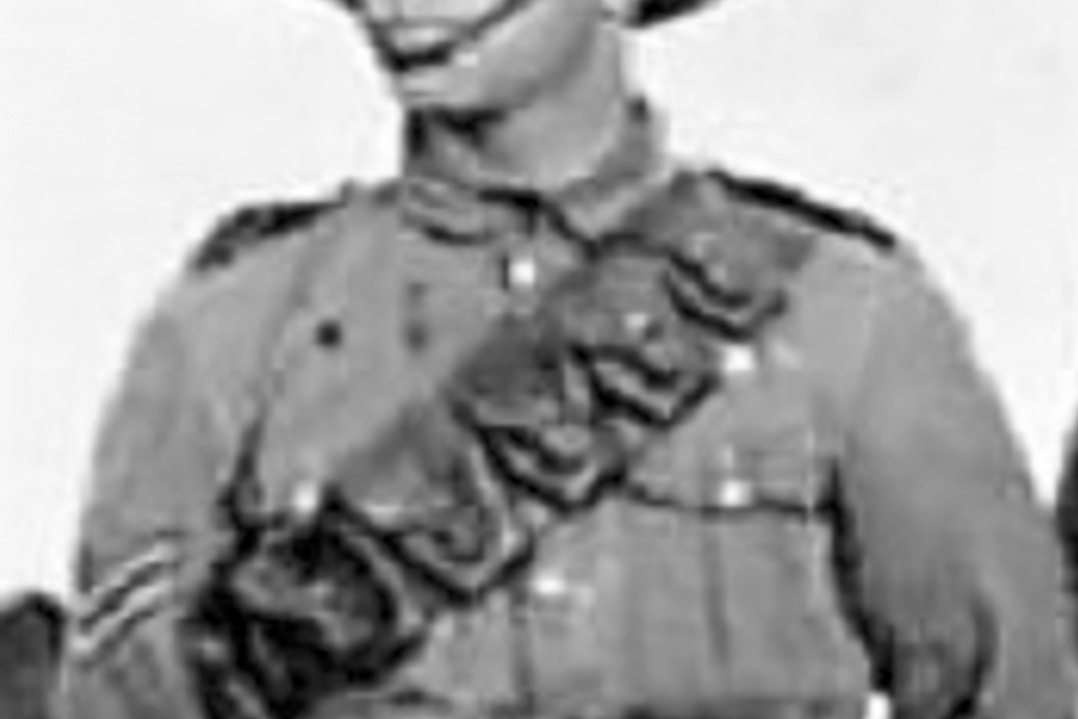
John was the eldest son of William Hanchet Francis and Johanne Harnath.
The family later moved to Yulecart and John attended Yulecart State School.
When he was older, he joined the 11th and 20th Light Horse at Hamilton, reaching the rank of sergeant.
As these were the second group to leave Hamilton, locals turned out to see the men march to the station, with the Hamilton Spectator describing it as a “stirring patriotic demonstration”.
Later joining the 4th Light Horse Regiment, with his previous experience John was given the rank of corporal.
John enlisted on August 21 1918 at Broadmeadows.
He was among the first enlistments from Hamilton and was allocated service number 102.
John’s regiment embarked on October 19 1914 on the transport ship A14 Wilshire.
The 4th Light Horse left Australia for Egypt, where they spent time training, knowing infantry battalions would soon be facing the action in the Dardanelles.
But because of big losses during the landing at Anzac Cove, it wasn’t long before members of the Light Horse joined them and in mid May 1915, the 4th Light Horse - minus their horses - arrived at Gallipoli.
In July, John had ear trouble and was transferred to a hospital in Malta.
He returned to Gallipoli on August 24, the regiment having just left Lone Pine for Ryries Post.
John was made a provisional sergeant in October 1915, then promoted to sergeant in December 1915.
That month the regiment left Gallipoli on December 10 and went to Lemnos for 10 days, then to Alexandria.
On June 10 1916 John left for France, arriving on June 17.
When John went to France, he and his mate Maurice Tilley parted ways - Maurice subsequently returned to Australia in September of that year.
John joined the 2nd Anzac Mounted Regiment D Squadron on July 7.
He was transferred to the 59th Battalion, Australian Infantry Battalion (formerly the 4th Light Horse, A Squadron, AIF), on September 2 1916 and promoted to second lieutenant.
The 59th was then at Rue de Bois, Flearbaix, France.
After the battalion did further training and took leave, John returned to the 59th on February 4 1917 at Deville Wood in the Somme.
He was promoted to lieutenant on February 14 1917.
While at Fremecourt, on March 27 1917 John was slightly wounded but remained with his battalion.
In June he spent time in Paris on furlough before rejoining the battalion on July 22 at the Lytham Camp.
In August 1917 the 59th Battalion was at Sercos before moving to the Steenvorde area in northern France September 17.
By September 25 the 59th Battalion was at Zillebeke Lake, Belguim, and due to move close to Hooge.
The following day they were at Black Watch Corner .
At 5.50am they attacked the German positions at Polygon Wood.
John, who was the battalion intelligence officer, was wounded, hit by a shell.
He was knocked unconscious and as the result of his wounds died shortly after.
John was a lieutenant at the time of his death from wounds on September 26 1917.
He was 25 years of age.
Witnesses thought he was buried at Black Watch Corner.
It was difficult day for the 59th Battalion with 46 men killed and another 17 unaccounted for.
On October 3 1917, the Yulecart community gathered in the Yulecart hall to welcome home another serviceman, Private Herbert Moore.
News of John’s death had not yet reached home.
A vote was held to decide which local soldier would receive a donated knitted scarf.
There was a tie with John and Private Ken Eales each receiving 91 votes.
It was decided a second scarf would be knitted so that neither soldier would miss out.
Little did they know that only one scarf was needed.
It was soon after that gathering that the Francis family was advised of John’s death.
There were several death notices for John published in the Hamilton Spectator newspaper, including one from Maurice Tilley.
Maurice had been there with John as he marched through the streets of Hamilton in August 1914, filled with a sense of adventure and patriotism.
As part of the 4th Light Horse Regiment, the two mates shared the experience of Gallipoli.
John is remembered on the Menin Gate Memorial in Ypres, Flanders, Belgium (the Commonwealth memorial to the missing of the Ypres Salient).
His name also appears in the commemorative area honour roll on panel 167 at Australian War Memorial, Canberra, and on the Hamilton War Memorial.
John was mentioned in dispatches on October 31 1917 by the Anzac commander, Lieutenant General Birdwood, for his gallant actions during battalion operations.
With thanks: Sally Bertram, RSL Military History Library. Contact Sally at sj.bertram@hotmail.com or call 0409 351 940.