General News
21 August, 2023
Remembering Vietname's 6RAR/NZ
August 18 commemorates the 50th anniversary of the end of Australia’s involvement in the Vietnam War. Throughout the year - not just today - Australians are encouraged to honour and remember the service of some 60,000 Australian men and women who...
August 18 commemorates the 50th anniversary of the end of Australia’s involvement in the Vietnam War.
Throughout the year - not just today - Australians are encouraged to honour and remember the service of some 60,000 Australian men and women who served in the Vietnam war from 1962-1973.
More than 500 Australians lost their lives and more than 3000 were wounded.
Local historian and war expert Charles Rees contributed this article to commemorate the anniversary....
This year also marks 60 years since the arrival of the Australian Army Advisors/Trainers (known as ‘the Team’) in Saigon, and August 18, the Battle of Long Tan, in Phuong Tuy Province, South Vietnam, which saw 17 Australian soldiers killed and 25 wounded in one day.
Near the village of Long Tan, in a rubber plantation, on August 18 1966, 108 soldiers of D Company 6RAR/NZ were ambushed by a vast Viet Cong (VC) force.
A ferociously intense battle took place in the space of approximately three hours, during a torrential tropical downpour.
The Eleventh Platoon were pinned down and received heavy casualties, until the Twelfth Platoon were able to assist their mates’ drawback.
Aerial bombing support was impossible due to torrential rain.
The saviour for D Company came in the form of the deadly accuracy of the Nui Dat based artillery, aided by a Kiwi/NZ forward observer attached to D Company.
As the pouring rain eased off, the VC incessant attack ceased then withdrew.
The next day revealed the outcome - it took three days to bury the 245 VC dead.
USA Commander, General Westmoreland, upon learning of the Aussie Diggers incredible feat, visited the burial party to lend moral support.
The Australian casualties on that day remain the highest in any one battle during the Vietnam War.
D Company was awarded the USA Presidential Unit Citation for their remarkable achievement at Long Tan.
The citation read: “D Company Sixth Battalion, Royal Australian Regiment, distinguished itself by extraordinary heroism while engaged in military operations against an opposing armed force in Vietnam on 18 August 1966.
“While searching for Viet Cong in a rubber plantation north-east of Ba Bia, Phuong Tuy Province, Republic of Vietnam, D Company met and immediately became engaged in heavy contact.
“As the battle developed, it became apparent that the men of D Company were facing a numerically superior force.
“The platoon of D Company were surrounded and attacked on all sides by an estimated reinforced enemy battalion, using automatic weapons, small arms and mortars.
“Fighting courageously against a well armed and determined foe, the men of D Company maintained their formations in a common perimeter defence and inflicted heavy casualties upon the Viet Cong.
“The enemy maintained a continuous, intense volume of fire and attacked repeatedly from all directions. Each successive assault was repulsed by the courageous Australians.
“Heavy rainfall and a low ceiling prevented any friendly close air support during the battle.
“After three hours of savage attacks, having failed to penetrate the Australian lines, the enemy withdrew from the battlefield carrying many dead and wounded, and leaving 245 Viet Cong dead forward of the defence position of D Company.
“The conspicuous gallantry, intrepidity and indomitable courage of D Company were in the highest tradition of military valour and reflect great credit upon D Company, Sixth Battalion, The Royal Australian Regiment and the Australian Army.”
Several Australians and the Kiwi received individual awards for valour.
6RAR Battalion troops were volunteers from Regular Army ranks and National Servicemen (‘Nashos’), which was reintroduced in March 1964 and ended December 1972.
Along with protesting against the Vietnam War, National Service created division in Australian public opinion, but met the requirement to build up the military service numbers for the Australian Army.
Service was determined by a “birthday ballot” for 20-year-old males, followed by a rigorous two year selection criteria of medical, psychological, education, and security, 12 months of intense, high-standard training, and 12 months ongoing duty either in Australia or overseas.
Contrary to popular belief, being a Nasho did not automatically mean a Vietnam War commitment.
Those conscripts who put their hand up to go to Vietnam were trained to the highest army standard fit for jungle warfare, and were assured access to the best, state-of-the-art logistics, weaponry and medical support for the wounded.
The war in Vietnam impacted on the entire Australian psyche as it was played out via television in our homes, creating much debate and divided opinion.
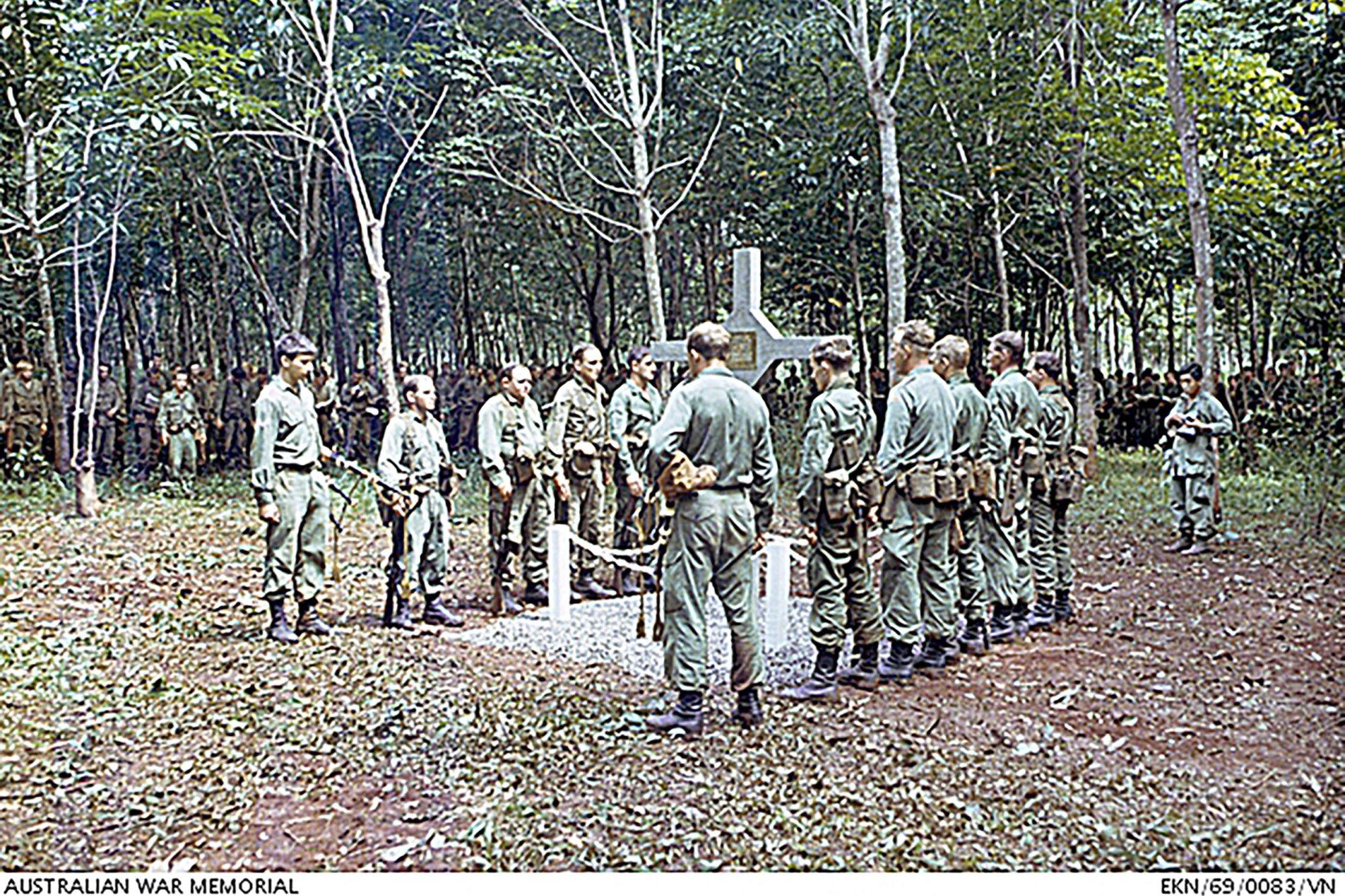
The Long Tan Cross was created as the battlefield memorial three years after the battle.
The Cross was removed in 1975, but was recovered by the Dong Nai Museum 1984 before being gifted to Australian in 2017 and placed on display at the Australian War Memorial in Canberra.
A replica Cross stands at the battlefield in place of the original and is still visited by Australian veterans of the Vietnam War.