General News
22 July, 2026
Rarefied air: Dimboola centenarian celebrates life
IT’S rare to become a centenarian, but Ian McRae has already accumulated time and a level of experience beyond that, celebrating another birthday in triple figures on Sunday in Dimboola with a growing legacy of generations of family.
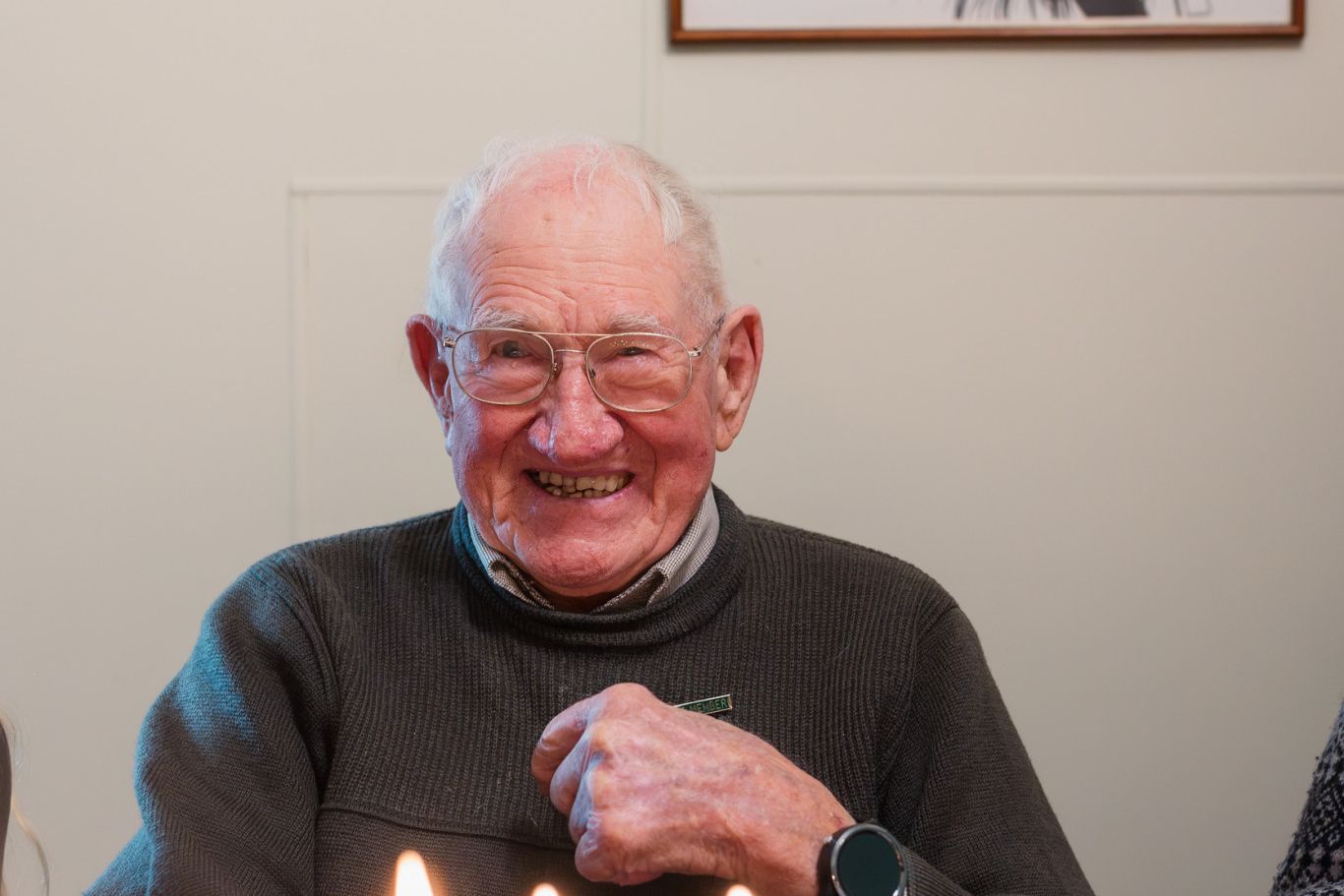
Just how rare? Official statistics from last year showed 7345 people in Australia were 100 and over, so only about one in 3800 Australians get to receive a royal greeting from the sitting monarch.
But Ian’s wall already has more than one – hanging there are already three official greetings framed, with his own from Queen Elizabeth, and then two more from King Charles, which attest to his late wife, Janet’s own age milestone and their diamond wedding anniversary, both in 2023.
“We were married for 75 years, and we both made 100,” he said.
He’s still lucid and enjoying life, and was more than happy to chat about his memories, some still vivid and clear, giving insight into the district’s changes and sharing wisdom from his years.
Born July 19, 1922, he grew up in Wallup on a roughly 1200-acre farm, the property having been in the McRae family for about five decades.
He left school at 14 – about the time the ABC radio mast was going up at Dooen – and following the outbreak of World War 2 in 1939, the latter part of his teenage years were marked by a growing social expectation for him to join the military.
“If you were young enough and fit enough, (it was) not really pressure, it was just the way things were going,” Ian said.
“It was when the Japanese were really running over this part of the world, and I used to dream about them coming across the farm.”
The combination of his own imagination, the attack on Pearl Harbour in December 1941, and the subsequent entry of the USA into the war also played roles, with the latter detail something Ian felt grateful for.
“That really changed the war,” he said.
“If it hadn't been for that, they (Japanese) probably would have invaded Australia.”
With the Air Force appealing to him more than the Army and potentially ending up in the trenches, early 1942 saw him sign up and head to Narrandera in NSW for elementary training on Tiger Moths, then return to Victoria.
“(I did) my service flying training at Point Cook, down in Geelong,” Ian said.
“Then there was a group of us that went through, and we camped at the MCG in those days – the Air Force took over the MCG.
“Spent about a month of July (1943) – that was the coldest I’ve ever been in my life! You had a blanket each and a mat – palliasse, as they called them – filled with straw.
“As you know, straw breaks down like chaff eventually.
“All these bloody concrete slabs in the stands. You went to bed with everything you had on!”
Due to his early exit from schooling, he had to do extra work to qualify, and it took some time before Ian ended up at Mount Gambier towards the end of 1944 and “spent the rest of the war there training navigators” on the Avro Anson, a British twin-engine reconnaissance aircraft – an example of which he noted is at the Nhill Aviation Heritage Centre.
He said the pay was good, but only once he was fully trained as a pilot, and with the war clearly heading towards an end in 1945, he was eventually grateful his entry into active duty took longer.
“I think it was 18 shillings we got,” Ian said.
“We lived quite well in those days. You used to go to the regatta here in Dimboola. You'd have a real good day on a couple of shillings.
“I often think if I'd went into the air force when I first joined up, I probably would have been flying bombers over bloody Europe, which wouldn't have been very profitable.”
When the war ended in August that year with the atomic bombs over Hiroshima and Nagasaki in Japan, Ian was discharged and immediately had an interview with Australian National Airlines, but his younger brother – who had been knocked back from service to help feed the country by staying on the farm – had plans that got in the way.
“I came home, and we were all accepted (with ANA), so I could have finished up an airline pilot,” he said.
“But dad said, ‘Oh, Greg's been wanting to go somewhere. You’d better come home and work on the farm for a while.’”
Settling back into Wallup, Ian met Janet through various dances, and they married on March 13, 1948, a decision he has repeatedly called the best thing he has done in his life.
With three children – Rob, Alison and Pam – they built a farm family life out at Wallup with cropping and crossbred sheep until 1979, when they decided to move into town, and the house they lived in was relocated – with some modifications – to Church Street, Dimboola.
Ian’s community involvement has also been solid, with service to various sports, Rotary, the Victorian Wheat Board, as Justice of the Peace, and his lengthy term on the Wimmera Shire Council from the mid 1960s to mid 1980s.
“I never got opposed!” he laughed.
“We had three-year terms, and I had seven of those. I ended up going out on my own accord. A few councillors stayed there for too long.”
He was also a keen pipes player and a founding member of the Wallup Pipe band – which lasted from 1939 to a few years ago and even played at Anzac Day marches in Melbourne – but realised a few years ago he had to pack it away.
“I got them out for my 90th birthday; I was going to play the bagpipes,” he recalled.
“We got them going pretty good, and then all of a sudden I started getting a bit giddy. I said, ‘Ah, righto, you're not going to do this!’”
The most recent activity he’s had to sadly give up is bowls at the local club.
“I bowled until I was 101,” he said.
“I started out when I was about 40, I think it was … because Rob, my son, started beating me at tennis!”
He said he’s fond of dogs, having owned mainly border collies on the farm and then introduced to corgis when they moved into town.
“They were good little house dogs,” Ian said.
“But he wasn’t allowed in the lounge room; he was barred from there.
“He lay at the door. We had some visitors here one time, and we went out to see them out to the car, and there was half a cake sitting on a little low table.
“We came back in, and it wasn't there. He was just licking his chops for the last minute!”
Ian said he’s marvelled at the changes and advances in technology over the years, especially in farming, seeing the whole transition from horse-drawn vehicles to GPS-controlled tractors and noting the benefits of direct drilling.
“The method of farming has probably changed so much in my lifetime,” he said.
“It’s why we’re growing crops in dry years.”
But he lamented some things he felt society had begun to lose.
"I think it's very important that people, if they are physically fit, should play sport," Ian said.
"Because that is self-discipline and respect and learning how to lose.
“Respect is disappearing nowadays, badly in my opinion. Respect and self-discipline.
“We were never ever disciplined physically; you just (did) the done thing.
“You always sat around the table for tea, and you weren't allowed to speak unless you were spoken to.
“Never enforced. It was just it. There was five of us and mum and dad sitting around the table.”
He acknowledged the difficulties in succession planning for farms, and was glad his own experience had gone well, with his son Rob then willing to take up the generational baton.
“When I was 80, we decided, Janet and I would sort of move out of the farm, and we had a trust, and we got out of that, and then went on a pension,” Ian said.
He has missed his wife for now over two years – Ian and Janet were centenarians together for just 12 days from her birthday on Christmas Eve 2023, but sadly she passed just after the New Year.
They had lived together until very near the end, but Ian said for the last “nine or 10 months” she was at the nursing home in Natimuk with dementia, where he visited regularly – and experienced another rare privilege.
“She did know me right to the finish.”

