General News
11 April, 2026
Patrick Coulton
VETRAN'S VOICE: Patrick Coulton was born in 1877 in the Scottish town of Duntocher.
After arriving in Australia, he was employed as a labourer / orchardist at Quantong.
The Quantong area is situated about 15km west of Horsham, Victoria, and was from the 1890’s a very productive vegetable and fruit growing region.
Patrick enlisted at Horsham on the 22nd of February 1916, at the age of 38 and was assigned to the 5th Tunnelling Company as a Sapper and given the service No 3910.
He embarked from Melbourne, on board HMAT ‘Warilda’ on the 25th of May 1916.
The 5th Tunnelling Company disbanded on arrival in France mid 1916 and all its personnel transferred to increase the 2nd Tunnelling Company.
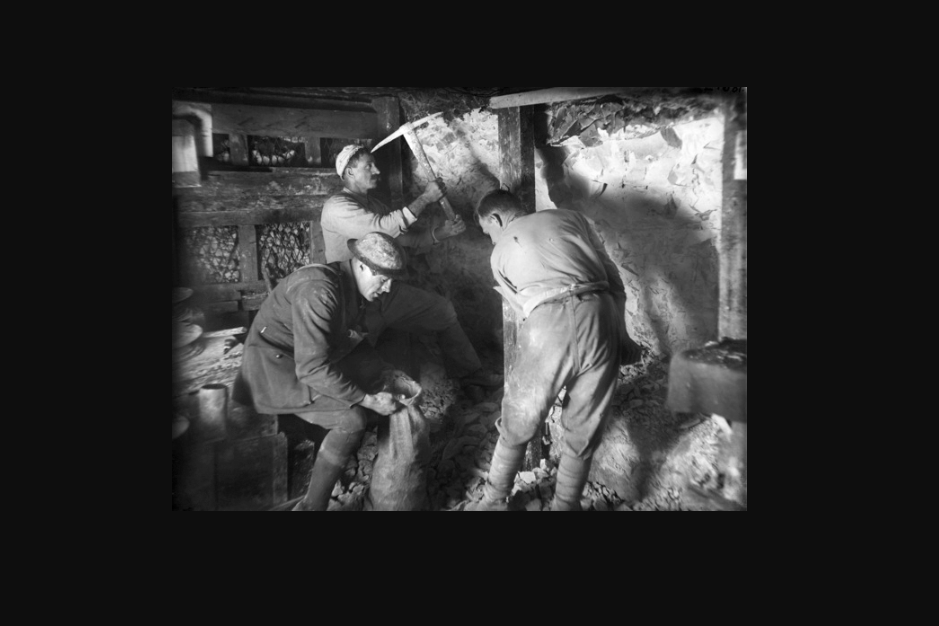
In World War 1, the war on the Western Front of Europe was extensively fought underground.
A massive network of tunnels was constructed by both sides.
They were not only used to provide protection away from surface conflict; deep mines were constructed beneath enemy lines, the shafts filled with explosives and detonated, causing mass fatalities and destruction.
Mining and tunnelling operations involved sinking shafts under the enemy's front line and digging a chamber at the end to be filled with explosives which were fired to disrupt the enemy defensive positions and shock and stun the defenders as an immediate precursor to attack.
This form of attack was highly dangerous as each side countermined the other using 'camouflets' (sub surface explosions) to collapse tunnels and allow the infantry to attack and kill the tunnellers in a hideous and claustrophobic environment deep underground and generally in darkness except for whatever feeble lighting could be managed.
Defensive mining involved the construction of underground galleries and chambers to shelter personnel from the devastation inflicted by Artillery above ground.
One of the biggest problems they had to deal with was the water table and preventing access of water into the tunnels and chambers.
On the 15th of October 1916, Patrick was sent to France, where unfortunately just nine days later was admitted with gastritis (inflammation of the stomach) and vomiting haematosis (the formation of blood) to the 1st Southern General Hospital.
From there, he was then transferred from Calais, France back to England for further treatment. Regrettably Patrick’s health did not improve, and he was repatriated and returned to Australia, leaving England in May 1917.
However, whilst on convalescence leave in England, Patrick married a Scottish girl and applied for her to be able to join him when he returned to Australia.
Arriving back in Australia, he was admitted to the Australian General Hospital for further treatment.
In October 1917, 12 months after he was first hospitalized in France, the Medical Board recommended Patrick was to be discharged.
He was discharged from the AIF on the 23rd of October 1917 as permanently incapacitated and unfit for duty because of Gastritis and Debility.
After his discharge, Patrick’s physical condition recovered enough to allow him to be able to take up an apple farm at Quantong, where he hoped he could buy land through the Government's assisted land scheme.
During the First World War, state and federal governments agreed to coordinate efforts to build farming communities of returned soldiers and their families.
Officials modelled soldier settlement on prior efforts to populate the Australian inland by splitting up large pastoral estates into small farms.
As soon as Australian soldiers began returning from the First World War, governments saw the need to recognize their contributions and to ensure that they had a source of income in civilian life.
The first soldier settlement schemes began in 1915 and continued for many years after the war.
Under the scheme, returned soldiers were eligible to apply for an allocation of land at minimal cost.
They were also given financial assistance to help them establish their properties for farming.
They were required to clear and fence the land, build houses and plant crops.
Patrick returned to Australia and settled at Quantong in August 1918, where he applied for a block of land through the Government Land Scheme.
Patrick was informed that his wife Margaret, who was still in Scotland at this time, could join him and had her passage booked for Australia. But owing to her being unable to get ready in time she had to cancel her passage to board the ship.
In a twist of fate, that ship was torpedoed and sunk soon after starting the voyage to Australia.
Unfortunately, the couple would never see each other again.
Before Margaret was able to board another ship to join Patrick in Quantong, he was killed in an accident in Horsham.
Patrick was heading home to Quantong on Christmas Eve 1918 in his spring cart, when his horse bolted in Natimuk Road throwing him onto the roadway.
Patrick was conveyed to the Hospital but was pronounced dead shortly after arrival. Sadly, Margaret also passed away just two months later in Scotland.
With no known family or relatives in Australia, Patrick is, very sadly, buried in an unmarked grave in the Horsham Cemetery.