General News
12 November, 2024
Battling on with a dark sense of 'tumour'
Emily Moore was only 29 when she discovered a lump in her breast.
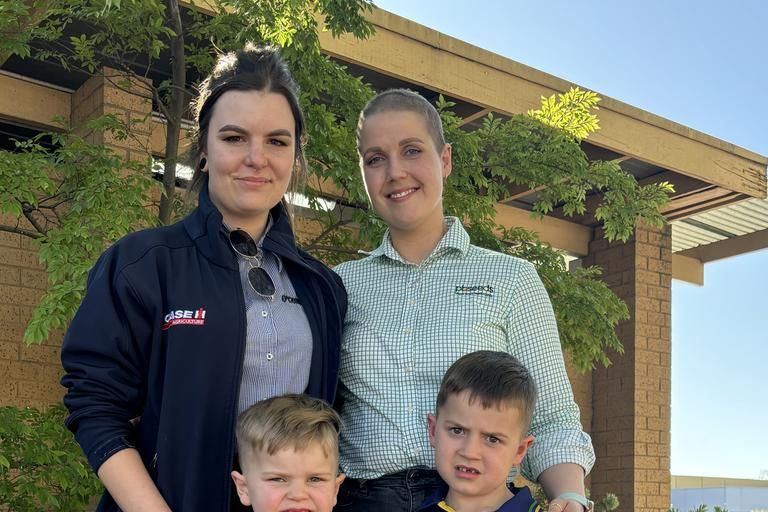
But with no family history of breast cancer, the mother of two, who barely drank, didn't smoke and had a relatively healthy lifestyle, didn't think it would be anything serious.
Almost a year after the initial discovery and shock diagnosis, after fighting her way through a mastectomy, lymphadenectomy and dozens of rounds of chemotherapy and treatments, Ms Moore said she relies on dark humour to keep her spirits up.
"I tell people I have a dark sense of ‘tumour’," she said.
"I also love a good cancer joke."
Ms Moore said she was initially so adamant that cancer was off the table, that she took the oldest of her two children - Connor, six, and Lincoln, four - to the follow-up appointment.
"It started in October 2023, when I scratched my chest and felt a lump," Ms Moore told The Horsham Times.
"I was freaking out for the day, but got myself in to see a doctor the following day, and by that time I had calmed down.
"I was 29 at the time, and was confident it wouldn't be anything.
“Having no family history, I wasn't worried, but I still went and had all the tests."
Ms Moore even had to wait six weeks for an ultrasound appointment because she wasn't considered at high risk of cancer.
The results arrived a couple of weeks after her ultrasound, and confirmed Ms Moore’s worst fear: cancer - stage three.
Not much else was known at that stage, and it was another six weeks before a biopsy could be arranged.
"I went and got my results on January 9, 2024," she said.
"At the time, it was a 30 millimetre lump in my chest, and it was Stage Three HER2 positive breast cancer."
The diagnosis was devastating.
"I did get pretty upset, because it is scary," Ms Moore said.
"I didn't know how bad it was, I didn't know what would happen, I have children that are young, and at the time I had only been with my partner, Sarvarna, for a month and I’d started a new job just a couple of weeks prior."
Around 15 to 20 percent of all breast cancer diagnoses are HER2 positive.
HER2 positive breast cancer spreads faster than other types, but is more likely to respond to the specifically-targeted drug treatments which target the protein receptors, meaning it is no longer a marker for poor prognosis.
Within weeks of the diagnosis, Ms Moore underwent surgery to remove the majority of her breast tissue and 14 nearby lymph nodes.
She has since battled through 16 rounds of aggressive chemotherapy, and 18 rounds of Anti-HER2 therapy, which will continue every few weeks until May next year
"They were not fun," Ms Moore said.
"I had a different symptom every week - one where I couldn't leave a dark room for bad light sensitivity.
“I lost all my hair, my eyebrows and lashes, I had a gum ulcer which has caused the gum between my tooth and the ulcer to disintegrate, so I'm now going to need a graft at some point."
Just two weeks ago, Ms Moore had a full mastectomy on the affected side, with an expander inserted to allow her to get an implant later - a prospect that, financially, on top of the overwhelming expenses of the cancer treatments, seems far beyond her reach.
"It's not deemed necessary," Ms Moore said.
"They get all high and mighty about your mental health, but it's like ‘oh, breast cancer survivor, you've had a mastectomy, you don't need your boobs to live, you will be fine'.
"But as a 30-year-old, that's extremely hard to deal with."
In the coming weeks Ms Moore is scheduled to begin daily radiation treatment in Melbourne, for at least three weeks.
Next year, she will have a preventative mastectomy on the other side.
October is Breast Cancer Awareness Month, but Emily has a more personal message for the community: if breast cancer can happen to her, it can happen to anyone.
"I had one of the lowest risks," she said.
"I had kids, I breastfed them, I had a healthy lifestyle, I didn't drink a lot, I didn't smoke, no risk factors and I still got it.
"So, my message would be for people to check regularly, every month.
“Generally they tell women to do your checks during your period because then they should be consistent.
"Just keep checking, because you aren't ever too young."
The out-of-pocket costs of fighting the cancer have substantially impacted the small family, who have established a GoFundMe to assist with expenses.
A silent auction is also being held at the Royal Hotel in Horsham on Friday, November 29 at 7pm. It is open to the public, and donations of auction items are being gratefully accepted