General News
26 July, 2023
Alice Clarke Lovett
Alice Clarke Lovett was born in Hamilton on June 16 1922. She was the daughter of Leonard (Leo) Charles Lovett of Warrnambool and Elsie Maud Clarke of Fitzroy. A Gunditjmara woman, she was from a family with a strong military history. Alice attended...
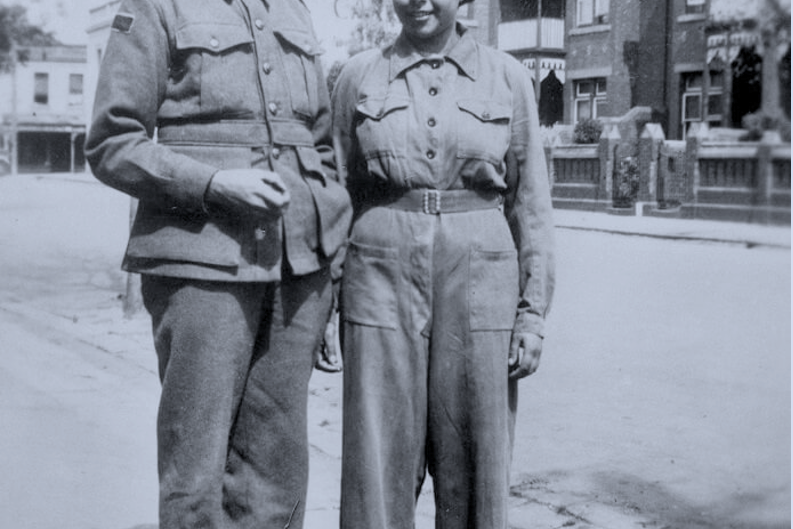
Alice Clarke Lovett was born in Hamilton on June 16 1922.
She was the daughter of Leonard (Leo) Charles Lovett of Warrnambool and Elsie Maud Clarke of Fitzroy.
A Gunditjmara woman, she was from a family with a strong military history.
Alice attended state school and later carried out domestic duties for a Mrs Biggs in Brighton.
During World War II Alice volunteered as an aircraftwoman in the Women’s Auxiliary Australian Air Force.
She enrolled at 1 RC Russell Street Melbourne and was assigned the rank Aircraftwoman 1, Messwoman 5.
At the time Alice was 19 years and 11 months of age and single.
Initially Alice was posted from 1 RC Russell Street Melbourne to 1 ITS at Somers on the Mornington Peninsula.
Between June 10 1942 and May 17 1943 she served as a messwoman across various RAAF bases in Victoria.
On her character and trade proficiency record, on December 31 1942 Alice was assessed as being of "particularly good character" with proficiency that was "satisfactory".
Among her postings as a messwoman was one to No 2 ANS at Nhill at the Nhill Flight Training School.
Her duties included preparing and serving meals for personnel.
Alice was discharged at her own request on May 17 1943.
She was 20 years and 10 months old and had served 342 days.
Alice was entitled to receive the War Medal 1939–1945 and the General Service Badge, which she applied for when she was living at 41A Elizabeth Street, Nathalia.
By then Alice was married and known as Alice McDonald.
On December 7 1944 she had married Signalman Claude Henry McDonald of the 10 Australian Dispatch Radar Section, who served in New Guinea, Torakina and Bougainville.
In order to receive her medals, Alice had to submit a statutory declaration to support her request for a copy of her discharge certificate as the original had been lost when she had moved house.
Alice died in Melbourne on May 10 1994, aged 71 years.
[CROSSHEAD]Family tradition
Alice’s father, Leonard Charles Lovett, was at the time of her birth a 36-year-old drover.
He had served in France and Belgium with the 39th Battalion and been wounded in an arm and a leg during the Battle of Passchendaele.
He had returned to the Western Front after being hospitalised.
At the war's conclusion, Leonard had arrived back in Australia and worked as a shearer.
He and his wife, Elsie, had had seven children.
Many of their children had gone on to serve in the military services.
Leonard’s brothers Alfred John Henry, Frederick Amos, Edward McDonald, Herbert Stahle and Samuel Alexander Peacock had also served.
They were the children of Hannah (née McDonald), a member of the Kerrup-Jmara clan of the Gunditjmara nation, and James Lovett, an Aboriginal man from South Australia.
The Lovetts of the Gunditjmara people, who hail from Lake Condah in south-west Victoria close to Heywood, are notable for having contributed more than 20 members in the service of Australia, including two women.
All served in Australia and/or abroad in wartime or in peace-keeping missions, ranging from the Western Front to countries including Japan, Vietnam, Korea, Timor and Afghanistan.
Remarkably, all returned home safely.
[CROSSHEAD]First Nations forces
In the 1940s most Australian First Nations women worked as domestic servants, with few opportunities for education or other employment.
The Woman’s Auxiliary Australian Air Force (WAAAF) services offered a different pathway, and at least 10 First Nations women are known to have served in the Australian army, air force or navy.
The WAAAF was formed in March 1941 after considerable lobbying by women eager to serve.
Next came the Women's Royal Australian Naval Service (WRANS) in April 1941.
The Australian Women's Army Service (AWAS) was the last of the women's auxiliary services to be formed, in August 1941.
Initially the women served as cooks, clerks and kitchen orderlies, but with demonstrated competence (and a shortage of men) their roles changed.
AWAS personnel manned anti-aircraft and coastal artillery gun sites and worked in ordnance, cipher, electrical, mechanical and intelligence units.
Women in the WAAAF collaborated with the airmen.
They maintained and armed aircraft, operated radars, drove trucks and instructed in drill – they did "everything but fly".
By 1945, 77 per cent of RAAF positions were available to women.
The jobs were equal but the pay was not: servicewomen were paid about half a man's salary.
Government policy exempted those “not substantially of European descent" from serving in the military, but by 1942 these rules were relaxed.
Alice Lovett was among those who enrolled in the WAAAF in 1942.